
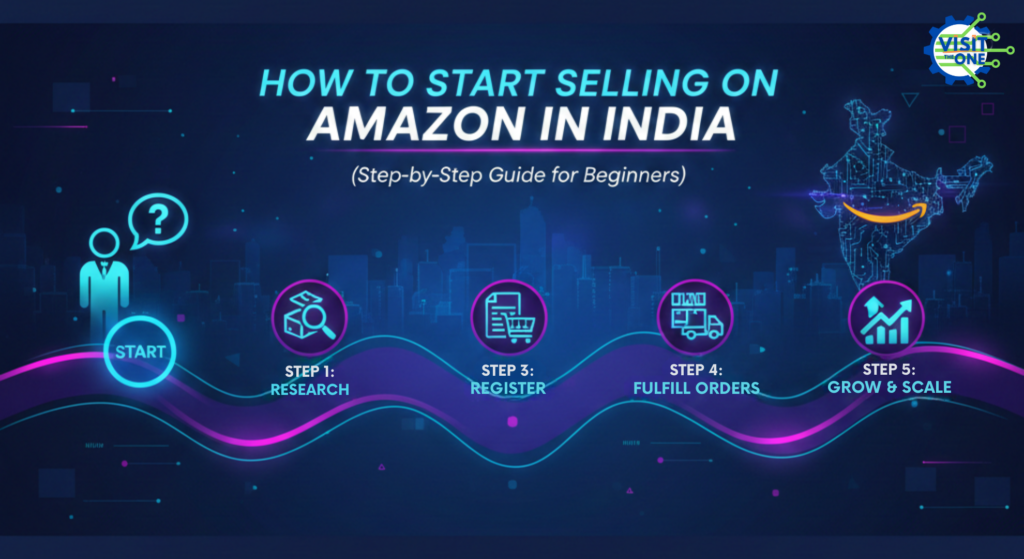
Starting an online business on Amazon is one of the most accessible ways for beginners in India to enter e-commerce. Amazon provides a ready-made platform with millions of active customers, nationwide delivery infrastructure, and built-in trust. However, many first-time sellers fail not because Amazon lacks opportunity, but because they start without understanding the complete process, compliance requirements, and long-term operational needs. Learning how to start selling on Amazon in India correctly helps beginners avoid costly mistakes and build a scalable business from the beginning.
This guide explains each step in detail, from registration and product selection to listings, fulfillment, and ongoing growth support, so beginners can start with clarity and confidence.
Why Amazon Is a Powerful Platform for Indian Sellers
Amazon India has transformed the way businesses reach customers. Sellers gain instant access to buyers across metro cities, tier-2, and tier-3 locations without investing in physical stores or large sales teams. Amazon’s trusted brand image encourages customers to buy from new sellers, provided listings are optimized and service standards are met.
For beginners, Amazon also simplifies payments, logistics, and customer support. However, success depends on understanding Amazon’s ecosystem, including ranking algorithms, performance metrics, and policy compliance. Sellers who approach Amazon with a long-term mindset and structured execution see significantly better results.
Step-by-Step Process: How to Start Selling on Amazon in India
Step 1: Understand Amazon’s Seller Models
Before registering, beginners must understand how Amazon structures seller accounts and fees. Choosing the right seller plan impacts tools, scalability, and growth potential.
Individual Seller vs Professional Seller
Individual sellers do not pay a monthly subscription fee but are limited in features and scale. This model is suitable for casual sellers or those testing a small number of products.
Professional sellers pay a monthly fee but gain access to bulk uploads, advertising tools, reports, and better scalability options. Most serious businesses and growth-focused sellers choose the professional seller plan to unlock Amazon’s full potential.
Step 2: Arrange Required Documents
Amazon requires sellers to submit accurate and verified documents to ensure compliance with Indian laws and marketplace policies. Document mismatches are one of the most common reasons for registration delays or account suspensions.
Documents Needed for Amazon Seller Registration
Sellers must provide a PAN card, GST registration, active bank account details, valid email ID, mobile number, and pickup address proof. All details must match across documents.
Proper documentation ensures smooth onboarding and reduces the risk of future account health issues.
Step 3: Register Your Amazon Seller Account
Once documents are ready, sellers can register through Amazon Seller Central. During registration, sellers enter business details, upload documents, verify their mobile number and email, and complete bank verification.
Category selection during registration is important. Choosing incorrect or restricted categories can cause listing problems later. Beginners should carefully select categories aligned with their products and compliance requirements.
Step 4: Choose the Right Products to Sell
Product selection is one of the most critical steps in learning how to start selling on Amazon in India. Many beginners fail because they choose products without analyzing competition, demand, or profitability.
Tips for Product Selection
Beginners should avoid heavily branded or highly competitive categories initially. Instead, they should focus on products with consistent demand, reasonable pricing gaps, manageable competition, and acceptable return rates.
Understanding sourcing costs, Amazon fees, shipping charges, and advertising expenses is essential before finalizing products. Smart product selection reduces risk and improves chances of early success.
Step 5: Create and Optimize Product Listings
A product listing is not just a product description; it is a sales page optimized for Amazon’s algorithm and customer behavior. Poorly written listings struggle to rank and convert, even if the product is good.
Key Elements of a High-Performing Listing
High-performing listings include keyword-rich titles, benefit-focused bullet points, detailed descriptions, clear specifications, and high-quality images. Backend search terms further support discoverability.
Optimized listings help products appear in relevant searches, attract qualified traffic, and improve conversion rates, which strengthens organic rankings over time.
Step 6: Decide Fulfillment Method (FBA or FBM)
Fulfillment choice impacts delivery speed, customer trust, and operational workload.
Fulfillment by Amazon (FBA)
With FBA, Amazon handles storage, packing, shipping, customer service, and returns. Products become Prime-eligible, which improves conversion rates and Buy Box chances. FBA is ideal for beginners who want hassle-free logistics.
Fulfillment by Merchant (FBM)
With FBM, sellers manage their own storage and shipping. While FBM offers more control, it requires strong logistics capabilities. Beginners often start with FBA and explore FBM later.
Step 7: Set Pricing and Manage Inventory
Pricing strategy directly affects sales velocity and profitability. Beginners often underprice products to gain sales, which can lead to losses and unsustainable growth.
Inventory planning is equally important. Running out of stock can hurt rankings, while overstocking increases storage fees. Balanced inventory planning supports stable growth and protects rankings.
Step 8: Start Amazon Advertising for Visibility
New listings require advertising support to gain initial visibility. Amazon ads help products appear in search results and competitor listings.
Beginners should start with small budgets, test keywords, analyze performance, and gradually scale profitable campaigns. Unplanned advertising often leads to high costs with limited results, making strategic ad management essential.
Why Beginners Struggle Without Expert Guidance
Many new sellers face listing suppression, poor ad performance, account health warnings, and low conversion rates. These issues often arise due to incorrect setup, lack of optimization, and misunderstanding of Amazon’s rules.
Knowing how to start selling on Amazon in India is only the first step. Continuous optimization, compliance monitoring, and performance analysis are required to sustain growth.
Why Amazon Seller Account Management Matters After Registration
Once a seller account is live, ongoing management becomes critical. Without regular optimization and monitoring, growth stagnates and risks increase.
Learn More About Amazon Account Management
To understand what professional support includes and why it is essential for scaling safely, read this detailed guide:
👉 Amazon Seller Account Management Services: What You Get & Why It Matters
https://visittheone.in/amazon-seller-account-management-services-what-you-get-why-it-matters/
This guide explains how expert management improves listings, ads, inventory control, and policy compliance.
How Professional Services Help New Amazon Sellers
Professional Amazon and e-commerce services help beginners avoid trial-and-error learning. Experts assist with correct account setup, keyword research, listing optimization, advertising strategy, and account health management.
This support accelerates growth, reduces losses, and helps sellers build a stable and scalable Amazon business. To explore complete Amazon and marketplace growth solutions, visit the services page here:
👉 https://visittheone.in/services/
Frequently Asked Questions (FAQs)
Is GST mandatory to start selling on Amazon in India?
GST registration is mandatory for most categories when selling on Amazon in India, except for a limited number of exempt categories.
How much investment is required to start selling on Amazon in India?
There is no fixed investment. Costs depend on product sourcing, inventory size, advertising budget, and fulfillment fees.
Can individuals sell on Amazon without registering a company?
Yes, individuals can sell using their PAN card and GST registration without forming a private limited company.
How long does Amazon seller registration take?
If documents are accurate, registration usually completes within a few days. Verification delays may occur if details do not match.
Is Amazon FBA recommended for beginners?
Yes, Amazon FBA is generally recommended for beginners because it simplifies logistics, improves delivery speed, and builds customer trust.